

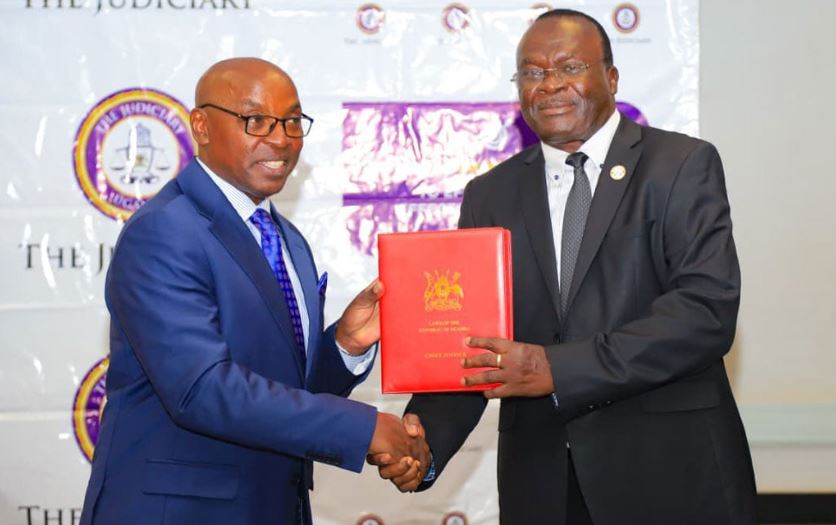
Retired Chief Justice Alfonse Chigamoy Owiny-Dollo yesterday formally handed over office, marking the end of a five-year tenure that senior Judiciary officials described as disciplined, reform-driven and collegial.
Speaking at the handover ceremony in Kampala, the Secretary to the Judiciary, Mr Pius Bigirimana, said the occasion was personally difficult for him, having worked closely with Justice Owiny-Dollo for decades.
“This afternoon is not a pleasant one for me because I have come to witness your handover,” Mr Bigirimana said. “I have known the Chief Justice since our university days, and when I was posted here, he was Deputy Chief Justice.”
Mr Bigirimana credited Justice Owiny-Dollo for supporting his initial 15-point reform programme aimed at strengthening financial discipline within the Judiciary. “Chief Justice, thank you for supporting that programme. It has since been running,” he said, adding that during their time working together, he never encountered any improper financial demands from the retiring Chief Justice.
“I thank you for giving me a peaceful tenure in the Judiciary. You are truly the grandfather of Alternative Dispute Resolution (ADR). Steering ADR has been your trademark,” Mr Bigirimana said. The Principal Judge, Justice Jane Frances Abodo, praised Justice Owiny-Dollo’s leadership, describing it as “exemplary and transformative”. “It is with profound respect and humility that I stand here at your retirement,” Justice Abodo said. “Your leadership has been nothing short of exemplary, and your contribution has extended far beyond the Bench.”
She noted that under Justice Owiny-Dollo’s leadership, reforms such as plea bargaining strengthened the work of the Office of the Director of Public Prosecutions (DPP).
“These reforms enhanced institutional solidarity, enabling the Judiciary to allocate Shs1b to the DPP’s office, support that will always be remembered,” she said.
Justice Abodo added that Justice Owiny-Dollo helped bridge the gap between the formal justice system and traditional dispute resolution mechanisms.
“You have led with wisdom and humility. On behalf of the High Court and the entire Judiciary, I thank you,” she said. In his farewell remarks, Justice Owiny-Dollo said he officially ceased being Chief Justice at midnight on Sunday upon attaining the mandatory retirement age of 70.
“I ceased being Chief Justice at midnight yesterday. Once a substantive Chief Justice retires, the Deputy Chief Justice automatically becomes the Acting Chief Justice, so what we are doing here is largely a formality,” he said. Reflecting on leadership, Justice Owiny-Dollo borrowed from William Shakespeare. “All the world is a stage, and men and women are merely actors. Shakespeare speaks of exits and entrances, and indeed this is my exit,” he said, drawing visible emotion from those in attendance.
He stressed that the achievements registered during his tenure were collective, not personal. “Whatever was achieved was a group effort,” he said.
“When there is credit, I prefer it be given to others, but when there are challenges, I take responsibility, even when I had no knowledge of the happenings.”
Justice Owiny-Dollo thanked the Judiciary’s top management and Supreme Court justices for their collegiality and urged them to maintain the same spirit.
“I leave confident that Magistrates’ Courts will continue to offer justice to every seeker,” he said.
He expressed personal fulfilment over the expansion of Alternative Dispute Resolution, revealing that he personally mediated a 21-year-old dispute involving the estates of Kabaka Mutesa and businessman Muhammed Kasasa.
“For me, the Judiciary has been family, and I do not say this lightly,” he said, adding that although he was retiring, he was not abandoning the institution. “When elders say someone has stepped outside, it does not mean they have abandoned the home. I still have trees planted here,” he said.

Justice Owiny-Dollo also disclosed that he would conclude a few pending matters assigned to him to avoid burdening other judicial officers. The law allows him three months to clear pending work, during which time he will not take on new cases.
Handover ceremony
During the ceremony, Acting Chief Justice Flavian Zeija was handed the Constitution, the Laws of Uganda, the Administration of the Judiciary Act and the official court seal, symbols of the office of the Chief Justice. In his remarks, Justice Zeija described Justice Owiny-Dollo as a rare leader.

“I do not know how to thank the Chief Justice emeritus. He led a team without bickering. This has been one of the best leadership periods in the Judiciary,” Justice Zeija said. “He allowed us to perform. His participatory and transformational leadership enabled us to achieve what we achieved,” he added.
Justice Zeija noted that Justice Owiny-Dollo assumed office when the Judiciary’s budget stood at about Shs180b and is retiring when it has surpassed Shs400b.
“He had a deep passion for Alternative Dispute Resolution. He was more than a boss, he was a friend,” Justice Zeija said. He also revealed that Justice Owiny-Dollo once attempted to mediate between the government and Lord’s Resistance Army leader Joseph Kony in Garamba National Park.
“When he narrated that story to me, it sounded like a horror movie. It was a matter of life and death,” Justice Zeija said. Quoting Shakespeare, Justice Zeija said public office was about service, not permanence.
“We all have exits and entrances. What matters is the legacy you leave behind, and you have left a huge one,” he said, wishing Justice Owiny-Dollo a peaceful retirement in Patongo. Justice Owiny-Dollo leaves office at a time when a presidential petition challenging President Museveni’s election victory has been filed by National Peasants Party presidential candidate Mr Robert Kasibante. It remains unclear whether the President-elect, who is a respondent in the petition, will appoint a substantive Chief Justice to hear the case or whether the Acting Chief Justice will constitute a panel to determine it.
Dollo’s background
Before ascending to the apex of the Judiciary, Justice Owiny-Dollo served as a High Court judge, a Justice of the Court of Appeal/Constitutional Court, Deputy Chief Justice and, earlier in his career, as a Member of Parliament representing Agago County in the Sixth Parliament (1996–2001). That dual exposure to both politics and the Bench shaped perceptions of him as a jurist deeply familiar with the realities of State power, but also attracted criticism from those wary of blurred institutional boundaries.
As a High Court judge, he presided over high-profile criminal matters, most notably the trial arising from the 2010 Kampala twin bombings, in which eight of the 13 accused were convicted for their role in the attacks that killed 76 people.
Others were acquitted after the court found that the prosecution had failed to meet the statutory threshold of proof, underscoring his emphasis on evidentiary standards. His most controversial moment came while serving as Deputy Chief Justice, when he chaired the Constitutional Court panel that upheld the removal of presidential age limits from the Constitution in Mbale.
The ruling cleared the path for President Museveni to seek additional terms beyond 2021 and remains one of the most politically charged judgments in Uganda’s constitutional history.
As Chief Justice, Owiny-Dollo presided over a Supreme Court that delivered one of its most far-reaching rulings in recent years, declaring it unconstitutional for military courts, including the General Court Martial, to try civilians.
The decision was widely welcomed by human rights advocates and legal scholars as a reaffirmation of civilian judicial authority and constitutional safeguards.
However, the Supreme Court under his leadership also faced unresolved controversy, including the 2021 presidential election petition filed by National Unity Platform leader Mr Robert Kyagulanyi, which was withdrawn midway amid allegations of judicial bias, claims that were never substantiated. Throughout his tenure, Justice Owiny-Dollo rejected accusations that the Judiciary was beholden to the Executive, maintaining that the institution acted independently within the confines of the law.