

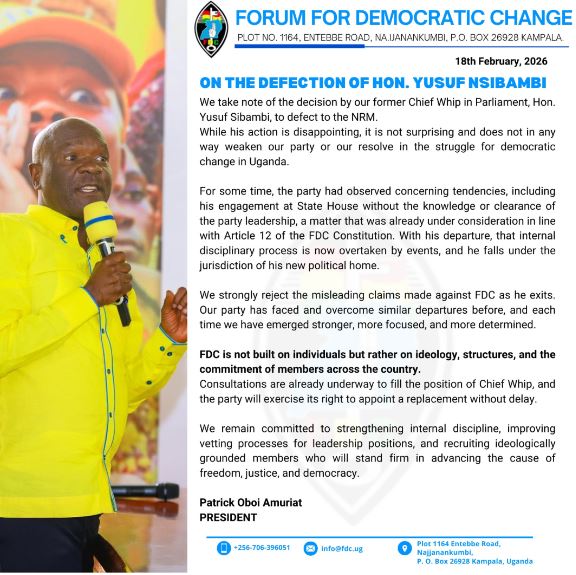
Forum for Democratic Change (FDC) has broken its silence on the defection of its former Chief Whip in Parliament, Yusuf Nsibambi, to the ruling National Resistance Movement (NRM), calling the move both “disappointing and shocking,” but insisting it will not weaken the opposition.
FDC President Patrick Amuriat Oboi said Nsibambi’s departure did not come entirely as a surprise, citing what he described as “uncomfortable tendencies” that had surfaced as early as last year.
“What shocked us most was not his leaving, but the manner in which he castigated the party while exiting, including claims that FDC collapsed after former Deputy Treasurer General Anita Among left,” Amuriat said. The party dismissed those remarks as exaggerated and politically motivated.
Amuriat further revealed that Nsibambi was already facing a looming disciplinary process over his alleged unauthorised engagement with President Yoweri Museveni at State House. According to FDC, Nsibambi’s visit without informing or seeking clearance from party leadership was a breach under Article 12 of the FDC Constitution.
“A disciplinary committee meeting had already been scheduled at party headquarters in Najjanankumbi to summon Nsibambi and other implicated members,” Amuriat said. “But with his defection, the process is now irrelevant. Nsibambi is under the jurisdiction of the NRM and should be disciplined by his new political home if need arises.”
FDC leaders compared Nsibambi’s exit to earlier defections, citing the late Eria Katigaya, Betty Kamya, Gregory Mugisha Muntu, and, more recently, Ibrahim Semujju Nganda and Lord Mayor Elias Lukwago, as examples of leaders who left but failed to weaken the party.
On succession, Amuriat confirmed that consultations are underway to fill the Chief Whip’s vacancy, with Soroti District Woman MP Anna Adeke Ebaju emerging as the top candidate. The party said Parliament remains in session until May, and it is within its rights to appoint a new whip immediately.
Reflecting on the defection, FDC said the episode underscores the need for stricter vetting of leaders, particularly those elevated to senior positions. The party vowed to recruit ideologically committed members from universities and colleges and ensure leaders are tested for consistency.
“Despite acknowledging that Nsibambi will be missed for his parliamentary role, he is replaceable, and the party will move on,” Amuriat concluded.