
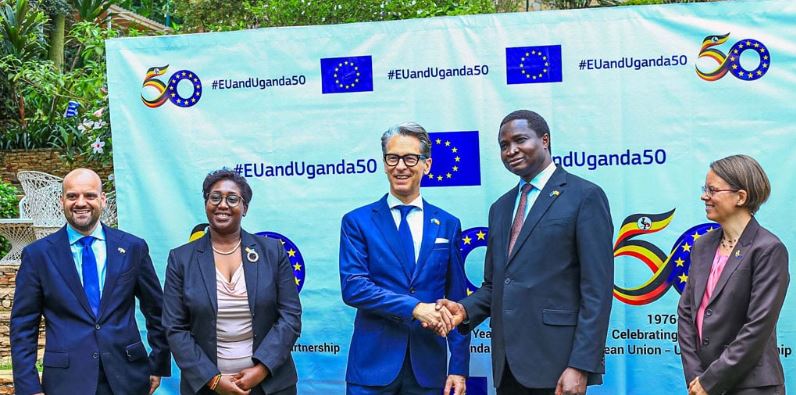
European Union (EU) has pledged to scale up investment in Uganda’s infrastructure, trade and job creation as the two partners mark 50 years of cooperation, promising to back the country’s transition to middle-income status with “serious, sustainable investment.”
Speaking at the EU Ambassadors Residence in Kampala on Thursday to launch year-long celebrations of the EU–Uganda partnership, the EU Head of Delegation, Ambassador Jan Sadek, said the bloc would deepen support under its Global Gateway strategy, targeting energy, connectivity, climate resilience and private sector growth.
“We are celebrating something simple, but powerful: a partnership that has lasted, adapted, and delivered,” Amb Sadek said.
Over the last five decades, he revealed, the EU has invested more than €5 billion in development cooperation in Uganda, alongside an estimated €5 billion in European private investment.
“That combination matters: public partnership and private enterprise, working in the same direction – toward opportunity, jobs, services and resilience,” he said.
Fresh push on infrastructure
At the centre of the EU’s next phase of engagement is a drive to mobilise large-scale infrastructure financing.
Amb Sadek cited the planned rehabilitation of the Nalubaale–Kiira hydropower complex, backed by a €30 million EU grant expected to unlock major loans from the European Investment Bank and partners, with works targeted to begin after phase one in 2026.
“That is what Global Gateway is meant to do: mobilise serious, sustainable investment – not for headlines, but for long-term impact,” he said.
The EU has previously supported key road projects including the Kampala Northern Bypass, the Mbarara–Katuna corridor and the Atiak–Laropi link, as well as long-standing investments in national parks, health and education.
Amb Sadek said cooperation is increasingly forward-looking, with emphasis on job creation, sustainable growth, governance and social inclusion.
Through the EU–Uganda Forest Partnership, he added, the bloc is backing landscape restoration and green value chains. “Protecting forests is not only about nature; it is also about livelihoods and green jobs,” he said.
Trade boom
Trade has emerged as one of the strongest pillars of the relationship.
Uganda benefits from duty-free, quota-free access to the EU market under the Everything But Arms arrangement. Since 2019, exports to the EU have nearly tripled from about €500 million to €1.5 billion. Between 2023 and 2024 alone, exports grew by 58 per cent, with Uganda recording a positive trade balance with the bloc since 2022.
“If one product symbolises our partnership, it is coffee,” Amb Sadek said, noting that Europe remains a key destination for Ugandan beans, with EU support focusing on quality improvement, certification and climate resilience.
He added that value addition, rather than volume alone, is now central. “The real story is not just volume. It is value: more processing, more quality, more resilience – and more income reaching farmers and cooperatives.”
He also welcomed the recent decision authorising exports of Ugandan farmed finfish to the EU, calling it “a strong signal of confidence in systems and standards” that opens new avenues for growth and jobs.
A fifth Uganda–EU Business Forum is planned later this year, with organisers promising it will be “bigger, more practical, and even more focused on investment and job creation.”
Government welcomes support
Representing the government, Mr John Leonard Mugerwa, the head of the International Legal and Social Affairs Department at the Ministry of Foreign Affairs, said Kampala values the partnership and is keen to see it expand.
“On behalf of the Government of Uganda … I would like to thank the EU delegation, the EU member states in general, for the partnership that we have with the EU that has now spanned 50 years, and we look forward to achieving much more in the future,” he said.
Mr Mugerwa said the benefits of cooperation are visible across the country.
“When we say that the partnership between the EU and Uganda is strong, it is because we see benefits, tangible benefits that we are deriving from that partnership, and they spread across the width and breadth of this country,” he noted.
With 50 per cent of Uganda’s population aged 30 years and below, he stressed that job creation remains critical.
On trade, he said exports to the EU have “well gone over 1.5 billion euros,” adding that it is one of the few trading relationships where the balance is in Uganda’s favour.
However, he signalled that Uganda’s anticipated transition from least developed country status to middle-income status will require new negotiations, including an eventual economic partnership agreement.
“Moving from least developed country to middle income comes with a lot of expectations, but at the same time, we have to make sure that we have some transition,” he said.
Coffee remains particularly significant, with the EU taking about 72 per cent of Uganda’s coffee exports, he added.
Mr Sadek said celebrations will extend beyond the capital, with events planned around Europe Day in May and at major expos, including the Pearl of Africa Tourism Expo and the Renewable Energy Conference.
He also announced that the EU Delegation’s new standalone office in Kampala will be completed later this year.
“It is not just a building. It is an important symbol of our partnership – and a springboard for the next 50 years,” he said.