

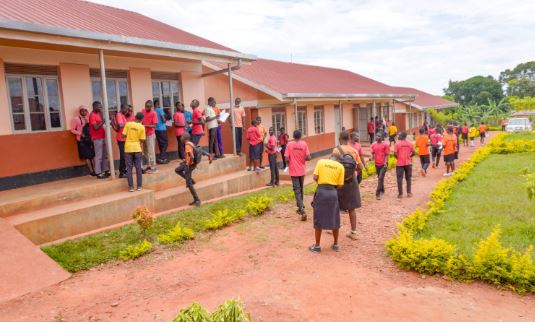
Government-owned secondary schools and tertiary institutions are hiring nearly 10,000 teachers outside the official payroll, accumulating billions in unpaid bills and struggling to collect school fees, a crisis that the Auditor General warns is steadily undermining the quality of education in Uganda.
In his December 2025 report to Parliament, Auditor General Edward Akol paints a troubling picture of overstretched institutions operating with chronic staffing gaps, rising debts and weak financial controls.
The audit reviewed operations in 498 secondary schools and 116 tertiary institutions for Financial Years 2022/23 and 2023/24 and Academic Years 2023 and 2024, generating 1,228 reports.
Financial statements from 255 secondary schools show payables rising from UGX35.6 billion in 2023 to UGX36.8 billion in 2024, a 3 percent increase. Similarly, 49 tertiary institutions reported payables increasing from UGX6.4 billion to UGX7.7 billion, a 21 percent jump.
Akol attributes the growing debt burden to weak enforcement of financial commitment controls, delayed government releases and shortfalls in school fees collection.

Failure to manage commitments properly, he warns, could expose institutions to litigation, reputational damage and additional costs, potentially creating a financial burden for government, particularly as some institutions transition into repurposed entities.
“The Accounting Officers should enforce financial commitment controls, prioritize essential payments and improve internal revenue collection,” Akol advised. The audit also uncovered rising receivables, money owed by students that schools have failed to recover.
In 278 secondary schools, receivables rose from UGX28.4 billion in 2023 to UGX30.5 billion in 2024, a 7 percent increase. For 57 tertiary institutions, receivables increased by 14 percent, from UGX5.17 billion to UGX5.9 billion.
Accounting officers blamed widespread financial hardship among parents, political interference discouraging strict fee enforcement, negative community perceptions and government policies limiting schools’ ability to penalize non-payment.
Akol recommended structured payment plans, digital payment platforms, recovery committees and exam clearance requirements to improve compliance.

In Academic Year 2024, only 11,665 (65%) of the required 17,894 staff positions were filled across 238 secondary schools.
At tertiary level, only 2,283 (57%) of 4,026 required positions were filled. To plug the gaps, 231 secondary schools hired 8,628 staff outside the government payroll, costing schools UGX61.3 billion and resulting in salary arrears of UGX1.6 billion.
Similarly, 48 tertiary institutions recruited 1,367 off-payroll staff, costing UGX7.26 billion and accumulating arrears of nearly UGX73 million.
The staffing deficit is further compounded by structural inconsistencies. A review of 65 secondary schools revealed that while the minimum teacher-student ratio requires 5,461 teachers, the approved staff establishment provides for only 3,517, leaving a significant shortfall.
Additionally, 221 secondary schools recorded classroom-to-student ratios exceeding the recommended 1:60, resulting in overcrowded classrooms that strain infrastructure and compromise learning outcomes.
School heads cited constraints within local government wage bills, delays in recruitment approvals involving the Ministry of Education and Sports and the Education Service Commission, and prolonged clearance processes.
In seven sampled institutions, 68 vacant teaching positions caused by transfers or retirements remained unfilled as of December 2024, despite requiring no additional wage allocation.
Akol warned that unused wage balances are often returned to the Treasury, even as classrooms remain understaffed.
“This situation highlights a systemic control weakness in staff recruitment, appointment and deployment processes,” he noted, adding that overstretched teachers face burnout, while schools pass financial pressures onto parents through increased fees.

The audit further revealed infrastructure gaps: 193 secondary schools lacked the minimum four staff housing units; 176 schools had desk-to-student ratios exceeding the recommended 1:3; and 36 secondary schools and 11 tertiary institutions lacked land titles for 55 parcels totaling 1,214 acres, exposing them to encroachment risks.
Headteachers blamed ownership disputes, shared land arrangements and lengthy administrative procedures for delays in land titling.
Meanwhile, 23 Primary Teacher Colleges earmarked for repurposing into TVET centres and other institutions remain idle, with no deployed staff or operational budgets, raising concerns over deteriorating public infrastructure.
In Academic Year 2023, secondary schools received UGX713.86 billion against an approved UGX784.64 billion, leaving a 9 percent shortfall.
In 2024, they received UGX862.8 billion out of UGX932.19 billion, a 7.5 percent deficit. The audit questions the impact of persistent underfunding on service delivery, particularly as institutions struggle to balance wage obligations, infrastructure needs and operational costs.
The findings present a system under sustained pressure: rising debts, weak revenue collection, staffing shortages and infrastructure decay, all converging to threaten education quality.
With nearly 10,000 teachers hired off payroll and billions in uncollected fees, the Auditor General’s report raises urgent questions about financial discipline, workforce planning and budget credibility within Uganda’s public education system.