
Newly re-elected Deputy Speaker Thomas Tayebwa has signaled a potential shift toward greater internal accountability and cross-aisle cooperation as Uganda’s 12th Parliament commences its five-year mandate.
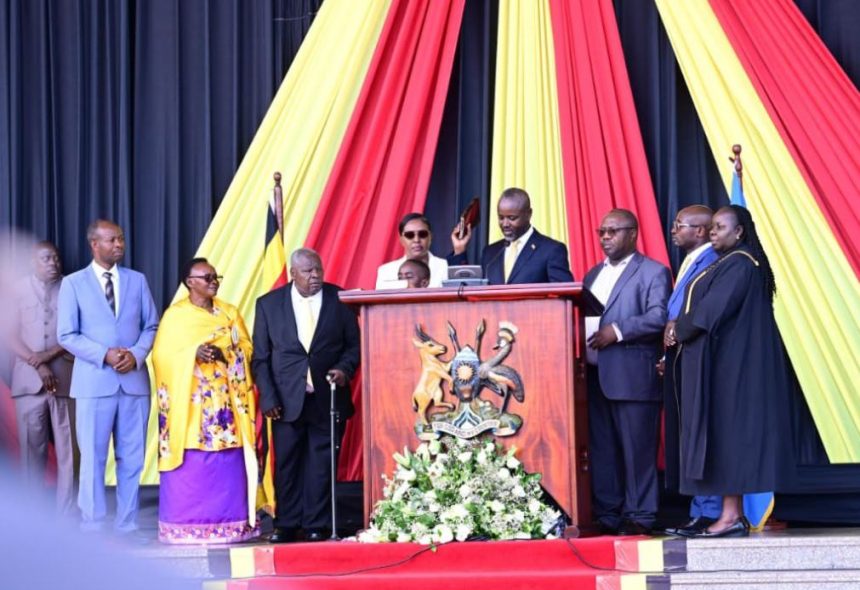
Speaking after his swearing-in at Kololo Ceremonial Grounds on May 25, 2026, the Ruhinda North MP declared intimate knowledge of the legislature’s shortcomings: “I know all the corners of the House. I know where we need clean-up. I know where we need to maintain the status quo.”
Tayebwa, who secured a commanding 457 votes in the secret ballot, pledged seamless collaboration with new Speaker Jacob Marksons Oboth-Oboth, describing their partnership as one of mutual quiet counsel. He framed the moment as a “renewed resolve” to elevate Parliament’s standing, emphasizing service over self-interest in alignment with repeated presidential guidance from Yoweri Museveni.
The remarks carry weight against the backdrop of the 11th Parliament’s turbulent legacy. That term was dominated by high-profile corruption allegations, including the iron sheets scandal implicating senior figures, controversial service awards (such as the Shs1.7 billion affair), and probes into lavish allowances and mismanagement.
Outgoing Speaker Anita Among faced UK and US sanctions over alleged significant corruption, alongside parliamentary raids and public outrage over perceived elite detachment amid widespread economic hardship.
Transparency International’s 2025 Corruption Perceptions Index scores Uganda at 25/100 (ranking 148/182), reflecting persistent public sector graft challenges that cost the economy an estimated UGX 10 trillion annually according to the Inspectorate of Government.
Multidimensional poverty remains entrenched, with roughly 30% of Ugandans below the poverty line and a Gini coefficient around 45.5, underscoring the urgency of effective oversight on public expenditure.
Article 79 of Uganda’s 1995 Constitution (as revised) mandates Parliament to make laws for “peace, order, development and good governance,” explicitly requiring it to “protect this Constitution and promote the democratic governance of Uganda.”
Complementary provisions empower committees with High Court-like powers for summoning witnesses and documents, while the budget approval and oversight roles are central to checking executive action.
Yet critics argue these powers have often been underutilized or compromised by ruling party dominance (NRM holds a strong majority in the new Parliament) and patronage dynamics. Tayebwa’s re-election and Oboth-Oboth’s landslide as Speaker further consolidate NRM influence, raising questions about genuine independence versus aligned reform.
A lawyer with degrees from Makerere University (BA Social Sciences 2005, LLB 2012), Tayebwa has represented Ruhinda North since 2016. He previously served on key committees for the National Economy and Natural Resources and held the Deputy Speaker role in the 11th Parliament. His business interests include directorship at Cholmat Investments.
In his speech, Tayebwa struck a collaborative tone toward opposition members: “If our mission is to get our people out of poverty, you will find in me a Deputy Speaker to work with.” He committed to balancing legislative support for government programs with robust oversight, while calling for a Parliament that earns public respect: “If you move out and say, ‘I am a member of the 12th Parliament,’ everyone should be able to say, ‘We appreciate the work you are doing.’”
Speaker Oboth-Oboth has similarly distanced the new leadership from past scandals, declaring the Speaker’s chair “is not a throne” and promising a people-centered, accountable House.
Analysts and citizens express cautious optimism mixed with skepticism. Afrobarometer data shows strong public support (around 77%) for parliamentary law-making primacy and oversight, alongside majorities favoring reforms like downsizing Parliament, ending free MP cars, and barring dual executive-legislative roles to curb costs and conflicts.
Governance observers note that meaningful change requires more than rhetoric. “Parliament’s effectiveness hinges on exercising its constitutional oversight tools independently, not just in alignment with the executive,” one analyst familiar with Ugandan institutions observed.
Priorities include transparent budget scrutiny, anti-corruption legislation enforcement, and addressing service delivery gaps in health, education, and agriculture to tackle poverty.Tayebwa’s “clean-up” pledge offers a compelling entry point for the 12th Parliament.
Whether it translates into tangible actions, such as strengthened committee probes, ethical reforms, or pro-poor legislation, will define its legacy in the eyes of a weary public demanding results over promises. For a nation navigating economic pressures and global scrutiny, restoring faith in its legislature is not merely institutional housekeeping; it is foundational to inclusive development.
This moment tests Uganda’s democratic resilience: can a dominant-party Parliament genuinely self-correct and deliver for its citizens? The coming months of budget sessions and legislative agenda-setting will provide early indicators.