
The Minister of Tourism, Wildlife and Antiquities Col(Rtd) Tom Butime has pledged to reduce human-wildlife conflict and expand tourism benefits for communities living around Uganda’s gorilla parks, as government seeks to address concerns over household incomes and benefit sharing.
The minister made the commitments in a speech delivered by Uganda Wildlife Authority (UWA) Commissioner for Biodiversity Management John Makombo during World Gorilla Day celebrations held on Thursday at Ruhija in Rubanda District.
Col Butime said progress in gorilla conservation has not eliminated concerns over human-wildlife conflict, household incomes and equitable sharing of tourism benefits.
“We shall strive to make our gorilla parks better places for continued benefit sharing through tourism employment, enterprise, opportunity and community programmes,” he said. He added that government would support initiatives that complement the existing revenue-sharing programme.
He also committed government to enforcing gorilla tracking rules on hygiene and health, keeping the prescribed distance from the animals and keeping unwell visitors away from them.
Col Butime warned against illegal tracking, saying some online operators were defrauding tourists while others were taking visitors to tracking points without permits.
“We need to jointly fight illegal tracking which steals our wealth as stakeholders,” he said.
He urged communities, lodge owners and others with information about illegal activities to report them to UWA offices, rangers and local leaders, and to report gorilla emergencies and suspected disease.
Uganda’s mountain gorilla population has increased significantly since 1991, when Uganda National Parks took over management of Bwindi and Mgahinga from the Forest Department and the Game Department. It grew from slightly more than 300 that year to about 500 gorillas in Bwindi in 2019, and the regional population is above 1,000.
A census was conducted in Bwindi in 2025, but its results are yet to be released. Field signs encountered during the exercise and births recorded over the past six years point to a possible further increase.
Col Butime said the growth has been accompanied by a change in attitudes among communities. Before 1991, Bwindi and Mgahinga were crop-growing and gold-mining areas, gorillas were regarded as beasts, and park management staff were viewed as enemies by some communities.
“The communities that used to fight the protectors are now actually the protectors of the mountain gorilla,” he said.
Speaking in his own capacity after delivering the minister’s speech, Mr Makombo said the economic value of gorillas should not be measured only by the statutory revenue-sharing allocation.
“The revenue sharing that is actually in the law, it is just a very small figure. It is a general figure for all the protected areas. 20 per cent,” he said.
He said lodges around Bwindi generate about Shs13 billion annually, while more than Shs5 billion reaches villages around the park through direct employment. Residents recruited from communities around Bwindi alone take about Shs2 billion to their villages each year through their earnings. The community campsite at Buhoma makes more than Shs500 million in net profit annually, outside the statutory arrangement.
Mr Makombo said local leaders’ concerns about the communities’ share had been noted, and UWA is reviewing the law.
“When leaders talk about revenue sharing, we pick those comments. We are now reviewing the law and seeing what percentage we can give to the communities without paralysing the institution,” he said.
He said the transformation of Ruhija shows how tourism has changed the area. When he worked in Bwindi from 2000 to 2004, he recalled having to carry food from Kabale because basic businesses and services were scarce.
“I didn’t know that Ruhija had expanded to now a big town. Big! I’m surprised. I’m shocked that Ruhija has expanded,” he said.
Mr Makombo urged young people and local entrepreneurs to position themselves to benefit from tourism through guiding, hospitality, cultural experiences, sustainable agriculture, transport and supplying goods and services. He said UWA’s recruitment policy gives priority to people from districts surrounding protected areas, with many employees around Bwindi and Mgahinga coming from Kanungu, Rubanda and Kisoro.
He also urged communities to protect the forests and plant more trees on their land, warning that continued loss of tree cover could create another source of conflict between residents and park authorities. The hills around Bwindi have sections with limited tree cover, exposing some slopes to soil erosion.
“If you have no trees on your land, you will have no alternative but enter the parks and get fuel wood from the park. That is going to have a conflict between us and you people,” he said.
A contract is in place for the road from Kanyantorogo through Togota and Ruhija towards Rubanda, while UWA plans to work with district authorities on access roads serving parks and surrounding communities. Mr Makombo called on districts to work with UWA on projects that can improve household incomes.
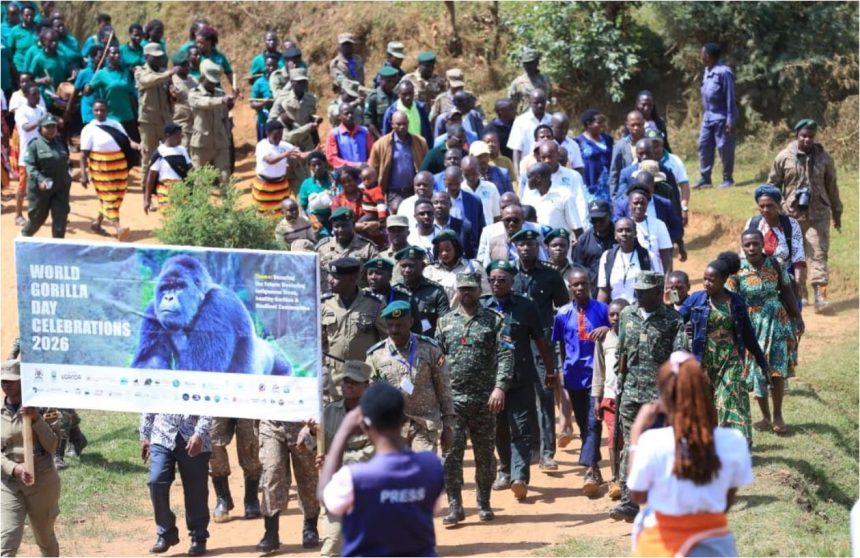
The celebrations brought together UWA staff, district officials, retired rangers and wardens, tourism operators, conservation partners, security agencies, media practitioners, school children and Miss Tourism Uganda. Mr Makombo recognised UWA staff who remained in the forest to continue monitoring and protecting the gorillas, as well as security agencies and conservation partners involved in the programme.