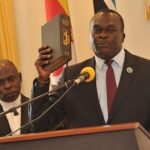

Minister for Justice and Constitutional Affairs, Norbert Mao, has called for a comprehensive review of Uganda’s Constitution, arguing that several key provisions, particularly those on decentralisation and presidential term limits, no longer serve the country’s democratic and governance needs.
Mao, who was declared the winner of the Laroo-Pece Division parliamentary race in Gulu City, said the Constitution, which was promulgated in 1995, requires an overhaul to address structural weaknesses that have steadily undermined effective governance.
He observed that Uganda’s decentralisation framework has been progressively weakened, blaming what he described as the hijacking of the system by bureaucrats in Kampala. According to Mao, local governments now exercise minimal discretion over funds remitted from the centre, rendering decentralisation largely ineffective.
//Cue in: “Our constitution, which…
Cue out…is completely undermined.”//
Mao suggested that Uganda could draw valuable lessons from Kenya’s county governance system, which he said has enabled unprecedented development and strengthened accountability at the grassroots.
“We could start with the Kenyan model. Kenya, through the county model, has been able to achieve unprecedented development for the people. It is easier for citizens to hold local governments accountable than to try to hold people in Kampala accountable,” Mao said.
The Justice Minister also renewed his criticism of the removal of presidential term limits, describing it as a gross abuse of power that severely eroded public trust and undermined democratic expectations.
According to Mao, the decision to scrap term limits was reckless and dashed the hopes of many Ugandans. He noted that even when citizens grow fatigued with a leader, constitutional safeguards are essential to guarantee peaceful transitions of power.
//Cue in: “I will go…
Cue out…the first time.”//
Mao further argued that Uganda must embrace inclusive governance, predicting that the next government could feature leaders drawn from across the political spectrum. He clarified that his decision to work with the ruling National Resistance Movement (NRM) does not preclude cooperation by other political actors.
“When I entered the cabinet and began working with the NRM, I did not lock the door behind me. I left it open,” he said. Mao, a long-time critic of the NRM-led government, signed a cooperation agreement with the ruling party in July 2022 and was subsequently appointed Minister for Justice and Constitutional Affairs by President Yoweri Museveni.
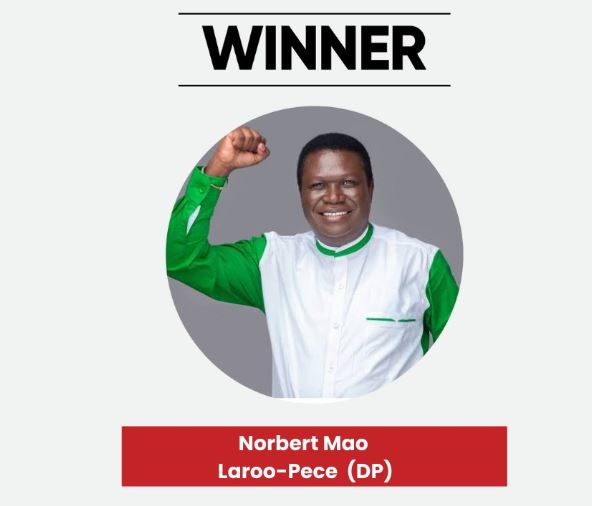
Mao, the president of the Democratic Party (DP), won the Laroo-Pece Division parliamentary race with 7,359 votes, defeating the incumbent, Fr Charles Onen, who polled 5,562 votes, marking his return to elective politics.