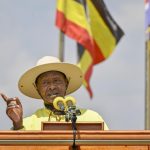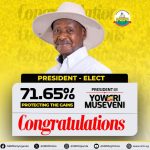

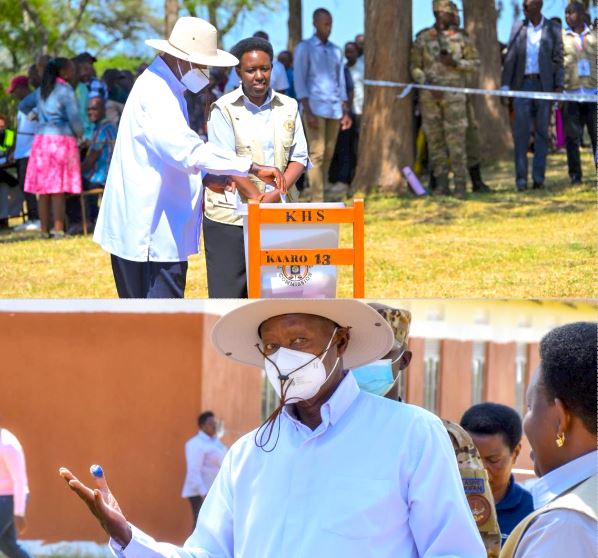
Incumbent President Yoweri Kaguta Museveni has been declared the winner of the 2026 presidential election after securing more than 50% of the votes cast in polls held countrywide on Thursday, January 15, 2026.
According to results announced by the Electoral Commission Chairperson, Justice Simon Mugenyi Byabakama, at the National Tally Centre in Lubowa on Saturday, Museveni garnered 7,946,772 votes, representing 71.65 percent of the total valid votes cast, thereby extending his leadership to a seventh term in office.
Robert Kyagulanyi Ssentamu, popularly known as Bobi Wine, who stood on the National Unity Platform (NUP) ticket, came second with 2,741,238 votes, accounting for 24.72 percent.
Other presidential candidates trailed in the following order based on the number of votes obtained. Nathan Nandala Mafabi of the Forum for Democratic Change (FDC) finished third with 209,039 votes, equivalent to 1.88 percent.
Museveni was followed by retired Major General Gregory Mugisha Muntu of the Alliance for National Transformation (ANT), who secured 59,276 votes, representing 0.53 percent.
Frank Bulira Kabinga of the Revolutionary People’s Party (RPP) came next with 45,959 votes, or 0.41 percent. Robert Kasibante of the National Peasants Party (NPP) obtained 33,440 votes, translating into 0.30 percent, narrowly ahead of Mubarak Munyagwa Sserunga of the Common Man’s Party (CMP), who polled 31,666 votes, representing 0.29 percent. Joseph Mabirizi of the Conservative Party (CP) closed the list with 23,458 votes, accounting for 0.21 percent.
Byabakama further reported that Uganda had a total of 21,649,067 registered voters. Out of these, 11,366,201 ballots were cast, reflecting a voter turnout of 52.50 percent. The election was conducted across 50,739 polling stations nationwide.
A total of 275,353 ballots were declared invalid, representing 2.42 percent of the total votes cast.
In the 2021 elections, Museveni was declared the winner with 6,042,898 representing 58.64% of the vote, while Kyagulanyi garnered 3,631,437 representing 34.83% of the vote. Out of the then 18 million eligible voters, 10 million turned up to vote.
In the 2016 elections, Museveni was declared the winner with 5,971,872 votes representing 60.62% of the vote. His closest challenger, Dr. Kizza Besigye of the Forum for Democratic Change (FDC) garnered 3,508,687 votes representing 35.61%.
In the 2011 elections, Museveni was declared the winner with 5,428,369 votes representing 68.38% of the vote. Dr. Kizza Besigye of the Forum for Democratic Change (FDC) garnered 2,064,963 votes representing 26.01%.
In the 2006 elections, Museveni was declared the winner with 4,109,449 votes representing 59.26% of the vote. Dr. Kizza Besigye of the Forum for Democratic Change (FDC) garnered 2,592,954 votes representing 37.39%.
In the 2001 elections, Museveni was declared the winner with 5,088,470 votes representing 69.45% of the vote. Dr. Kizza Besigye of the Forum for Democratic Change (FDC) garnered 2,029,190 votes representing 27.96%.
In the 1996 elections, Museveni was declared the winner with 4,458,195 votes representing 74.33% of the vote. The late Dr. Paul Kawanga Ssemogerere of the Democratic Party (DP) garnered 1,416,140 votes representing 23.61%.

Despite longstanding allegations of election rigging, voter manipulation, and repression of opposition voices, Museveni, during an exclusive interview with Sky News earlier this week, placed the blame his political rivals, accusing opposition groups of consistently undermining Uganda’s electoral process, alleging that Bobi Wine fraudulently obtained 2.7 million votes in the 2021 polls.
Ugandan President Yoweri Museveni has pushed back against critics who say he’s held onto power for too long. The 81-year-old spoke to @YousraElbagir about why he’s seeking five more years in office. The election campaign has been marred by mass arrests of opposition supporters. pic.twitter.com/8nVqkKEO0a— Sky News (@SkyNews) January 15, 2026
Addressing accusations of state-led crackdowns on opposition figures, particularly during periods of heightened political tension such as 2018, Museveni defended the government’s actions as lawful enforcement measures.
Museveni argued that opposition actors frequently violate the law, maintaining that security interventions were necessary responses to unrest rather than acts of politically motivated persecution.
Museveni further contended that Uganda’s repeated electoral outcomes reflect leadership capability rather than manipulation.
Museveni asserted that if alternative candidates over the past six election cycles had demonstrated the capacity to govern effectively, they would have been elected. According to the president, his continued hold on power is rooted in experience and competence, not coercion.
Responding to criticism regarding his age and extended tenure in office, Museveni rejected claims of political obsolescence.
“I’m not dead, I’m not senile, but I am still around and I have some knowledge,” he said, framing himself as a national asset.
In contrast, Kyagulanyi detailed alleged acts of intimidation and repression in a statement posted on his X (formerly Twitter) account on Saturday afternoon. He described a late-night raid on his home in Magere, claiming that military and police forces cut electricity, disabled CCTV cameras and deployed helicopters over the area.
Police, however, denied claims that Kyagulanyi was under arrest. Police spokesperson Assistant Commissioner of Police (ACP) Kituuma Rusoke stated that Kyagulanyi was free to leave his residence, although access to the premises was restricted.
According to him, the controlled access was intended to prevent the property from being used to incite violence.
“It should not surprise you when we have a pickup or two near the residence of Kyagulanyi,” Rusoke said, addressing the press earlier today.
Museveni is now set to extend his forty-year rule after having first gained power in January 1986, when his National Resistance Army (NRA) captured Kampala and ended years of political instability and civil war.
He came to power after a five-year guerrilla war (1981–1986) against the government of Milton Obote, whose second presidency followed the overthrow of Idi Amin in 1979.
Museveni presented himself as a reformer who would restore security, rebuild state institutions, and end sectarian politics that had plagued Uganda since independence in 1962.