

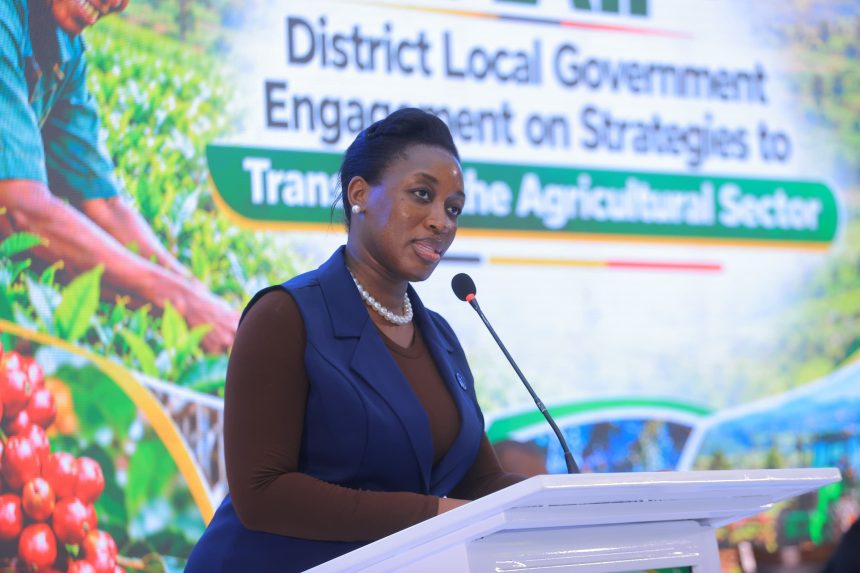
State Minister for Local Government, Hon. Justine Nameere, has called on local governments to strengthen the delivery of agricultural services and make better use of available resources to accelerate the transformation of Uganda’s agriculture sector.
Speaking at the District Local Government Engagement on Strategies to Transform the Agricultural Sector at Imperial Royale Hotel, Kampala, Nameere said effective decentralisation remains central to improving service delivery, with local governments playing a critical role in implementing national policies and programmes at community level.
She said agriculture remains fundamental to Uganda’s livelihoods and economic transformation, requiring stronger coordination between central and local governments to improve production, productivity, markets and value addition.
Nameere outlined key responsibilities of local governments in agricultural transformation, including establishing and maintaining production infrastructure, organising agricultural extension services, mobilising communities to participate in Government programmes, promoting climate-smart agriculture, supporting mechanisation, and planning and implementing agriculture-related budgets and programmes.
She also highlighted the role of local governments in facilitating access to agricultural inputs and markets, connecting producers to buyers, providing market information and promoting value addition to support the transition of households from subsistence to a commercial money economy.
However, Nameere identified weak extension service delivery, inadequate staffing, limited funding and resource constraints as some of the challenges affecting agricultural transformation at local government level.
She urged local governments to strengthen extension services and ensure that farmers receive practical, timely and relevant technical guidance.
Nameere also called for greater attention to irrigation, noting that climate variability and recent droughts have demonstrated the need to reduce dependence on rain-fed agriculture. She cited farmers who have invested in small-scale irrigation as examples of what can be achieved when water is made available for production.
She further emphasised the need for stronger coordination between central and local governments in implementing agricultural interventions and ensuring that investments deliver value to communities.
The Minister directed local governments to prepare, within two weeks, reports on agricultural facilities that are non-functional or underutilised, indicating the specific reasons for their status, including possible challenges related to electricity, land, infrastructure, corruption or other institutional constraints.
She said the reports would support coordinated action by the relevant Ministries and enable Government to develop interventions to restore the facilities to full functionality.
“We need to put our Ministries together, coordinate with the Prime Minister and make a case for these facilities in Cabinet, and make sure that as we move forward, all these facilities are functional,” Nameere said.
She reaffirmed the Ministry of Local Government’s commitment to coordinating, supporting and monitoring local governments to ensure they effectively deliver their delegated functions and remain accountable for results.
Nameere urged local government leaders to use the resources available to them efficiently and work closely with the Ministry of Agriculture, Animal Industry and Fisheries and other stakeholders to ensure that Government interventions translate into tangible improvements in the lives and livelihoods of farmers.