

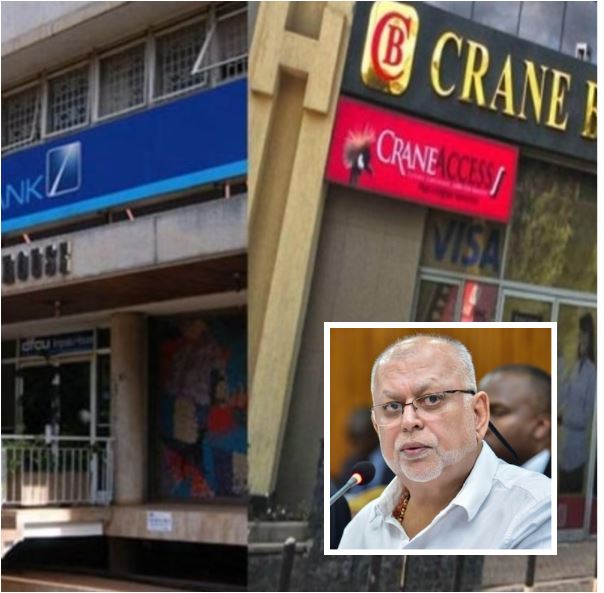
Businessman Dr Sudhir Ruparelia and other former shareholders of Crane Bank are set to continue their long-running dispute over the bank’s takeover before the High Court of Justice in London.
The 16-week hearing, which begins Monday, October 5, 2026, will focus on events surrounding the 2016 intervention in Crane Bank and the subsequent transfer of much of its assets and liabilities to DFCU Bank.
The case, listed as Crane Bank Limited & Ors v DFCU Bank Limited & Ors under Claim No. CL-2020-000859, involves a series of allegations, including claims of corruption, unlawful conduct and conspiracy. It also raises broader legal questions about whether an English court can examine actions taken by institutions of a foreign state.=
At the heart of the case is Dr Ruparelia, who founded Crane Bank and was its principal shareholder. Together with the other claimants, he is challenging the circumstances under which the bank was taken over and its assets subsequently transferred.
The London proceedings mark another major stage in a dispute that has continued for almost a decade. The claimants will have an opportunity to present their case through documentary evidence, expert testimony and legal submissions.
The dispute began in October 2016 when the Bank of Uganda placed Crane Bank under statutory management, citing serious undercapitalisation. Three months later, in January 2017, the central bank placed the lender under receivership.
Arrangements were subsequently made for a substantial portion of Crane Bank’s assets and liabilities to be transferred to DFCU Bank.
The former shareholders have challenged aspects of that process, alleging that the takeover formed part of a broader scheme involving unlawful conduct and corruption. DFCU and the other defendants have rejected the allegations and maintain that the acquisition was conducted lawfully.
DFCU has also referred to the involvement of PricewaterhouseCoopers in the process. Among its arguments is that the claimants did not challenge the administration of Crane Bank before Ugandan courts at the time the events occurred.
The case involves seven claimants and 15 defendants, making it a complex and potentially document-intensive trial.
The claimants are Crane Bank Limited, Dr Sudhir Ruparelia, Jyotsna Ruparelia, Meera Ruparelia, the estate of the late Rajiv Ruparelia, Tom Mugenga and Sheena Ruparelia.
Among the defendants are DFCU Bank Limited, DFCU Limited, former DFCU executives, British International Investment, Norfinance, Rabo Partnerships, Arise and several individuals connected to the institutions involved.
During the trial, the court is expected to consider a large volume of material, including correspondence, presentations, transaction records and other documents relating to the takeover and subsequent transfer of the bank’s assets and liabilities.
A notable aspect of the proceedings is that the Bank of Uganda itself is not named as a defendant.
Its absence is connected to legal principles such as state immunity and the foreign act of state doctrine. These issues present the London court with questions about how far it can go in examining decisions made by a foreign state institution.
The claimants argue that the events surrounding Crane Bank’s takeover cannot be fully understood without considering the decisions made during the regulatory process.
The defendants, however, are expected to rely on the fact that the central bank is not a party to the case while defending the legality of the transactions in which they participated.
In 2023, the English Court of Appeal allowed the claims to move beyond the jurisdictional stage, ruling that the foreign act of state doctrine did not prevent the case from being heard at that stage.
The claimants are also expected to rely on material from a 2019 Ugandan parliamentary inquiry, which criticised aspects of the handling of Crane Bank’s takeover and questioned the legality of some actions attributed to the central bank.
They have also referred to the conviction in the United States of Hong Kong businessman Patrick Ho in a separate bribery case involving Uganda’s then Foreign Minister. The significance and evidential value of such material will be determined by the London court.
For Dr Ruparelia, the trial represents another important chapter in the legal dispute that followed the collapse of Crane Bank.
The bank was once among Uganda’s largest indigenous commercial lenders, and its takeover and eventual transfer to DFCU generated considerable public debate about the treatment of locally owned banks and the powers of financial regulators.
The London proceedings now bring some of those disputed events before an international commercial court.
The case is also being closely followed because of its potential relevance to banking regulation, commercial law and cross-border disputes involving private investors and foreign state institutions.
Greenberg Traurig is representing the claimants, while Freshfields represents DFCU. Arise is represented by A&O Shearman, while Milbank represents Rabobank.
The trial is expected to last about 16 weeks, after which the court will deliver its judgment at a later date.
The opening of the hearing marks a significant point for Dr Ruparelia and the other former Crane Bank shareholders, who have spent years pursuing legal challenges over the bank’s takeover. The London court will now examine the evidence and arguments surrounding one of Uganda’s most closely contested banking disputes.