

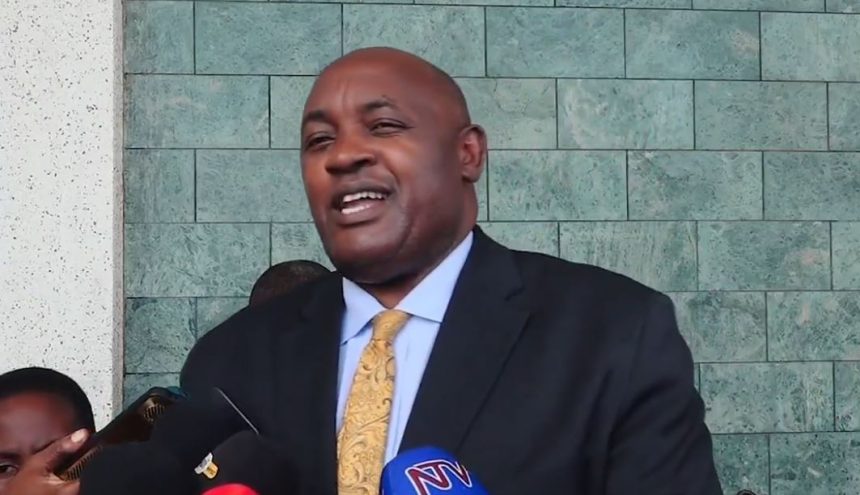
Health Minister-designate Dr. Chris Baryomunsi has defended government’s controversial decision to stop paying allowances to medical interns, arguing that internship is primarily a continuation of professional training rather than formal employment.
Baryomunsi made the remarks on Tuesday after appearing before Parliament’s Appointments Committee for vetting as President Yoweri Museveni’s nominee for Minister of Health.
His comments come amid mounting opposition from medical professionals who warn that the policy could undermine healthcare delivery, worsen youth unemployment among health workers, and discourage aspiring doctors from pursuing medical careers.
“In Uganda, we have been giving an allowance to these medical doctors, but now there are many training institutions and universities producing doctors,” Baryomunsi said.
“The question has been: whom do you pay? Do you pay only those from government universities? What about those from private universities? Cabinet discussed this matter and agreed that internship should be considered a continuation of training.”
Under Uganda’s medical training system, graduates must complete a year-long supervised internship in accredited health facilities before they can be fully registered and licensed to practice independently.
The proposed change is contained in the National Health Education and Training Policy, which government officials argue seeks to harmonize medical training and address the growing number of graduates entering the health sector.
Baryomunsi acknowledged that the policy has attracted criticism but insisted that internship differs from employment.
“Internship is not employment per se. It is a period when medical graduates strengthen their clinical skills. The policy has both advantages and disadvantages, but it has already been approved and we shall assess its implementation as we move along,” he said.
However, the proposal has triggered fierce resistance from the Uganda Medical Association (UMA), whose leaders argue that interns perform critical frontline duties in public hospitals and should therefore continue receiving financial support.
During an online consultative meeting over the weekend, UMA President Dr. Frank Asiimwe described the policy as “dead on arrival,” accusing policymakers of ignoring the realities faced by young medical professionals.
“These are Ugandan children and Ugandan patients we are talking about. This policy makes no sense and will be difficult to implement,” Asiimwe said.
The association argues that medical interns often work long hours under challenging conditions, helping to manage patient loads in referral hospitals and health facilities that are already grappling with staffing shortages.
The dispute comes against the backdrop of broader challenges in Uganda’s health sector. Although the country has significantly expanded medical education over the last decade, producing thousands of doctors, nurses and allied health professionals annually, many graduates struggle to find employment due to limited government recruitment.
Health sector stakeholders have repeatedly warned that Uganda faces the paradox of producing increasing numbers of health workers while many public health facilities remain understaffed because of wage bill constraints and delayed recruitment.
The Ministry of Health has consistently reported staffing gaps across Health Centre IIIs, Health Centre IVs and district hospitals, particularly in rural areas.
Asked about his priorities should he be confirmed as Health Minister, Baryomunsi said his focus would be on strengthening preventive healthcare and addressing persistent staffing shortages.
“We have a double burden of disease. We continue to battle communicable diseases associated with poverty and underdevelopment, while non-communicable diseases linked to lifestyle changes are also increasing,” he said.
“We must invest more in prevention and health promotion while also strengthening curative and rehabilitative services.”
He added that government intends to recruit more health workers and deploy doctors to lower-level health facilities, although he acknowledged that the current decentralized recruitment system has limited absorption of qualified graduates.
“There are many medical schools producing doctors and health workers, but many are not being absorbed into the health system,” he noted.
Meanwhile, Baryomunsi dismissed concerns over recent public criticism from Chief of Defence Forces Gen. Muhoozi Kainerugaba regarding his return to Cabinet, insisting he remains focused on his work.
“The President is the appointing authority and he has appointed me. I am not worried. I don’t want to give attention to trivial issues,” he said.
As government prepares to implement the new health training policy, attention is likely to shift to whether authorities can persuade medical professionals that removing internship allowances will not worsen existing challenges facing Uganda’s healthcare system.