

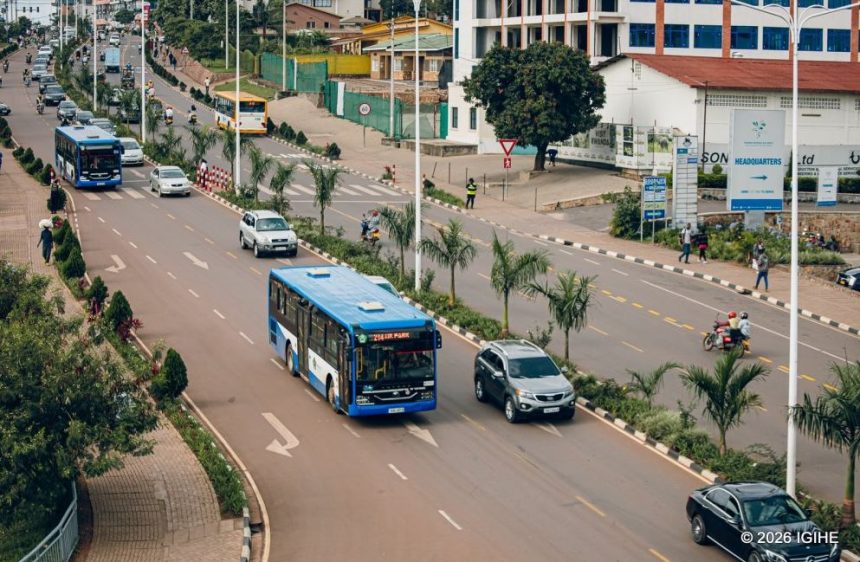
New data from the National Institute of Statistics of Rwanda shows that 60.9% of commuters in Kigali travel to work on foot, while 25.8% rely on buses and motorbikes, and 13.3% use private vehicles.
However, these figures could soon change significantly as Rwanda rolls out sweeping reforms in its public transport system.
For years, many Kigali residents have avoided public buses due to persistent challenges, including delays, overcrowding, and limited route coverage. As a result, motorbikes have become a preferred alternative for faster and more flexible travel.
Yet, experts argue that motorbikes are not a sustainable long-term solution. In many developed cities—often used as benchmarks for Rwanda’s urban planning—motorbikes are rarely used for public passenger transport, serving mainly for private use instead.
There have previously been discussions about phasing out motorbike taxis altogether, but authorities recognized their critical role in employment, particularly for youth, and in providing last-mile connectivity. Still, their long-term future remains uncertain, largely dependent on the success of ongoing improvements in public bus services.
From “Twegerane” to Modern Transit
Rwanda’s transport evolution has seen several transformations. One of the most memorable phases was the era of the Toyota Hiace minibuses, commonly known as “Twegerane” due to their cramped conditions. These were later replaced by larger buses such as the Toyota Coaster, alongside the emergence of major transport companies including Volcano Express, Horizon Express, Kigali Bus Services, Royal Express, and Rwanda Federation of Transport Cooperatives.
Despite these changes, commuters have continued to voice concerns over poor service, including delays, hygiene issues, and mistreatment by some operators.
Government Reforms Gain Momentum
In response, the Government of Rwanda has introduced a series of reforms aimed at making public transport more efficient, accessible, and inclusive for all users—regardless of income or nationality.
Key measures include the introduction of new and sufficient buses, expansion of routes, and the establishment of Ecofleet, a state-affiliated company tasked with overseeing bus operations.
One of the most notable changes is the introduction of dedicated bus lanes, allowing buses to operate more efficiently and reduce travel time. In addition, a new digital system is being piloted to provide passengers with real-time information on bus arrival times and seat availability.
While these reforms were already part of Rwanda’s long-term strategy, they have gained urgency amid rising global fuel prices, partly linked to geopolitical tensions such as those involving the United States and Iran.
The broader goal is clear: encourage shared transport to reduce fuel consumption and protect the national economy from external shocks.
Early Impact: Faster, Safer, More Reliable
Initial feedback from commuters and operators suggests the reforms are already making a difference—particularly the policy allowing buses to depart without waiting to fill up and the use of dedicated lanes.
Rosinette Gaju, a Kigali resident who previously relied heavily on motorbikes, says the changes have transformed her daily commute.
“These reforms are very good. I used to spend up to two hours waiting for buses to fill up before departure, and I would arrive at work late,” she said. “Now buses leave within 10 to 15 minutes, and we get to work on time. Everyone is seated, and I no longer feel the need to use motorbikes, which are often risky.”
Bus driver Eric Dusabeyezu, who operates on the Downtown–Kimironko route, echoed similar sentiments, noting that dedicated lanes have significantly improved efficiency.
“We can now provide better service because we are no longer competing with other vehicles. Once I reach areas with bus lanes, movement becomes much faster since there is no traffic ahead except at designated stops,” he explained.
Meanwhile, fellow driver Ishimwe Carmel highlighted the impact of Ecofleet’s operational model, which prioritizes service quality over passenger volume.
“In the past, we waited to fill buses to maximize revenue, but now the focus is on service delivery. Passengers are happier, and some have even stopped using their private cars to take the bus instead,” he said.
Oswald Abenawe, Head of Operations at Ecofleet, confirmed that the new system has already reduced waiting times from 10 minutes to just five during peak hours.
He added that while the dedicated bus lane system currently operates on five major roads, there are plans to expand it further across Kigali as infrastructure improvements continue.
A Turning Point for Urban Mobility
As Kigali continues to modernize its transport system, the shift toward efficient, high-capacity public buses could redefine how residents move around the city.
While motorbikes remain an important part of the current ecosystem, the success of these reforms may gradually reduce reliance on them—marking a significant step toward a more sustainable and organized urban transport future.