
A delegation of Ugandan lawmakers has turned to Kenya for insights on teacher remuneration, curriculum reforms, inclusive education, ICT integration and education funding as Uganda seeks to strengthen its education sector.
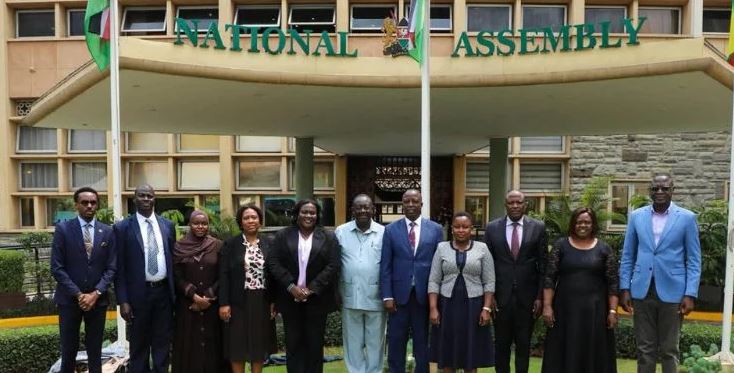
The delegation, drawn from Uganda’s Parliamentary Committee on Education and Sports and led by Deputy Chairperson Emmanuel Ongiertho, MP for Nebbi Municipality, held a benchmarking meeting with Kenya’s National Assembly Departmental Committee on Education at Parliament Buildings in Nairobi on August 19.
According to the Ugandan MPs, the meeting offered an opportunity to examine Kenya’s experience implementing education reforms and managing challenges that affect both countries.
Ugandan MPs on Teacher Remuneration and Accountability
During the benchmarking, the delegation raised concerns about the salary disparity between science and humanities teachers.
The lawmakers noted that Uganda had previously adopted different salary structures for secondary school teachers depending on the subjects they taught, a policy they said had contributed to dissatisfaction among educators and affected morale.
The MPs sought to establish whether Kenya faces a similar challenge and how teacher salaries are structured.
Responding to the concerns, the Kenyan committee, led by Chairperson Honorable Julius Meli, a member of the National Assembly of Kenya for Tinderet Constituency, explained that teachers employed by the Teachers Service Commission (TSC) are placed within established salary scales.
Further, he emphasized that differences in earnings mainly arise from allowances rather than separate salary structures based on teaching subjects.
Meli also argued that teachers working in hardship areas receive hardship allowances, while teachers handling learners with special needs qualify for additional special-needs allowances.
On teacher accountability and performance management, Jerusha Momanyi clarified that Kenya uses both school-based supervision and technology-driven systems to monitor attendance and performance.
Additionally, teachers must record attendance, while the TSC uses the Teacher Performance Appraisal and Development (TPAD) platform for assessment by school administrators.
‘’Teachers are required to record their attendance, while the TSC uses the Teacher Performance Appraisal and Development (TPAD) system to monitor performance. The system allows teachers to submit performance information electronically, while school heads and principals play a role in assessing their work,’’ Jerusha Momanyi noted.
According to the lawmakers, teachers who absent themselves from duty without authorization face disciplinary action.
Uganda Examines Kenya’s CBC and Digital Learning Mode
The Ugandan MPs also sought details on Kenya’s Competency-Based Curriculum (CBC), particularly the policy of automatic learner progression.
Regarding the learners’ progression, Kenyan MPs outlined that government policy generally discourages repeating classes.
However, the lawmakers noted that some parents can occasionally request that learners repeat a grade to improve academic performance.
The committee further stated that Kenya’s education structure includes two years of Early Childhood Development Education, six years of primary school, three years of junior secondary education, and three years of senior secondary education before tertiary studies.
In contrast, Uganda’s education system follows a seven-year primary cycle, four years of lower secondary education, and two years of advanced secondary education before university.
While Uganda has introduced curriculum reforms aimed at developing practical competencies, its system remains more heavily reliant on national examinations than Kenya’s CBC competencies.
ICT integration emerged as another area of interest, with Kenyan lawmakers citing that technology is embedded across learning areas and increasingly used to support instruction in subjects such as History, Geography, and Religious Education.
Additionally, they noted that the government has invested in digital learning infrastructure, including interactive screens and other educational technologies, to enhance classroom learning.
Inclusive Education and CDF Management
The benchmarking session also examined Kenya’s approach to inclusive education and the management of public development funds.
On funding, the delegation sought clarification on the management of the Constituency Development Fund (CDF).
Kenyan MPs explained that the fund operates under a legal framework that prevents Members of Parliament from directly handling or authorizing expenditure.
The Ugandan lawmakers expressed interest in the CDF model, citing that Uganda largely relies on central government allocations, local government funding and support from development partners for education projects.