
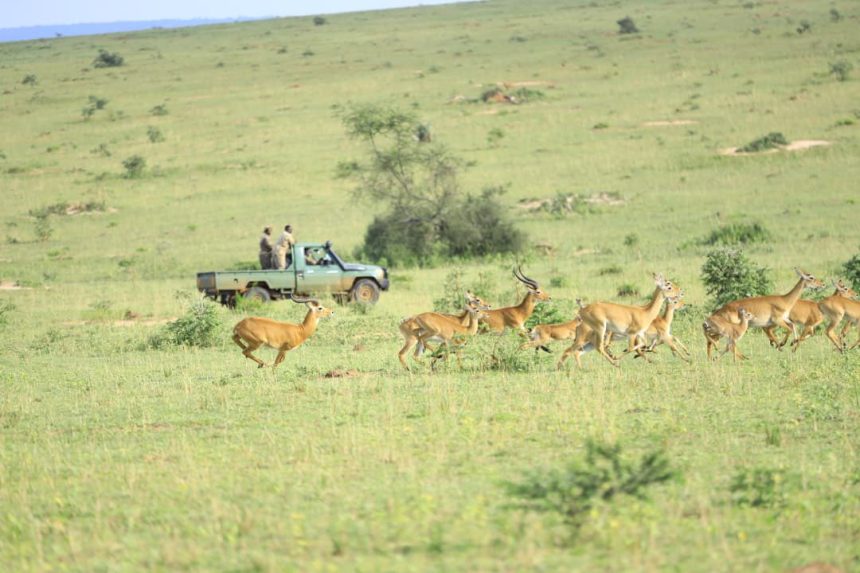
Uganda is relocating 200 Uganda kob from Murchison Falls National Park to Pian Upe Wildlife Reserve to strengthen the species’ population, expand its range, and enhance wildlife diversity across protected areas.
Uganda Wildlife Authority (UWA) is conducting the translocation in phases as part of a broader conservation strategy aimed at establishing stronger wildlife populations in suitable habitats throughout the country.
The exercise highlights the growing use of wildlife translocation as a conservation tool in Uganda, where authorities are seeking to reduce the concentration of some species in a limited number of protected areas while restoring populations in others.
Restocking wildlife reserves
Translocation allows conservation authorities to introduce animals into areas where populations have declined or disappeared, provided the habitat can support them.
UWA has previously used the approach to restock protected areas with key wildlife species. In January 2026, four southern white rhinos were moved from Ziwa Rhino Sanctuary to Ajai Wildlife Reserve as part of efforts to establish a rhino population there.
The current movement of Uganda kob follows a similar conservation principle. By establishing a population in Pian Upe, authorities aim to increase the species’ presence beyond Murchison Falls and create another viable population in a different protected area.
Spreading wildlife populations across several locations can also reduce the risks associated with having a species concentrated in one area. Disease, habitat changes, poaching and other threats can cause substantial losses when a population is confined to a single location.
The distribution of animals across suitable habitats can provide greater resilience by ensuring that a setback in one area does not necessarily affect the entire population.
Protecting ecosystems
The benefits of translocation extend beyond the animals being moved.
Uganda kob are herbivores that interact with vegetation and form part of food chains involving predators and other species. A significant decline or disappearance of a key species can alter relationships within an ecosystem.
Restocking an area with wildlife can therefore help restore ecological interactions that may have weakened when animal populations declined.

However, moving animals successfully requires careful planning. Authorities must establish whether the destination has sufficient food and water, suitable habitat and adequate security before the operation begins.
Dr Patrick Atimnedi, Commissioner for Veterinary Services, said diversifying wildlife habitats has become increasingly important because of pressures affecting some protected areas.
“With the oil drilling happening at Murchison Falls National Park, constant encroachment and poaching, it is important that we diversify the habitats of these animals,” Atimnedi said.
His comments underline the need to assess the results of a translocation beyond the initial release. Conservation authorities must monitor whether the animals survive, adapt to their new surroundings and reproduce.
Genetic diversity and long-term survival
Translocation can also help address challenges associated with isolated wildlife populations.
When a small population remains separated from others for an extended period, limited genetic diversity can become a concern. Introducing animals from another population can increase genetic variation and potentially improve the population’s ability to withstand future pressures.
This makes the selection of animals for translocation an important part of the process. Authorities have to consider where the animals are coming from, their suitability for the destination and the conditions they will encounter after release.
The operation also carries risks. Capture and transportation can cause stress or injuries, while animals released into a new environment must adapt to unfamiliar conditions and may face competition for food and territory. There is also a need to manage the risk of disease transmission.
Expanding wildlife and tourism opportunities
Wildlife translocation is also linked to Uganda’s efforts to spread conservation and tourism opportunities across its protected-area network.
In July 2026, UWA moved three Nubian giraffes from Murchison Falls National Park to Ajai Wildlife Reserve to increase the reserve’s giraffe population and support biodiversity restoration.
UWA has also undertaken translocations involving species such as Uganda kob, giraffes, zebras and topis between protected areas.
The objective is to develop healthy wildlife populations in different landscapes rather than concentrating conservation gains in a small number of locations. Stronger wildlife populations can also increase the potential of reserves to attract tourists, researchers and conservation organisations.
Uganda’s protected-area network includes 10 national parks, 12 wildlife reserves, five community wildlife management areas and 13 wildlife sanctuaries, according to UWA.
The network gives conservation authorities a range of habitats in which wildlife populations can potentially be established, strengthened and managed.
For the 200 Uganda kob being moved to Pian Upe, the ultimate measure of the operation will not simply be the number of animals that reach the reserve safely. Their long-term survival, adaptation, reproduction and role within the reserve’s ecosystem will determine whether the translocation achieves its conservation objectives.