
Businessman and philanthropist Dr. Sudhir Ruparelia has pledged to sustain the humanitarian legacy of his late son, Rajiv Ruparelia, by continuing to support and host the Pan-African Pyramid (PAP) Global Awards on an annual basis.
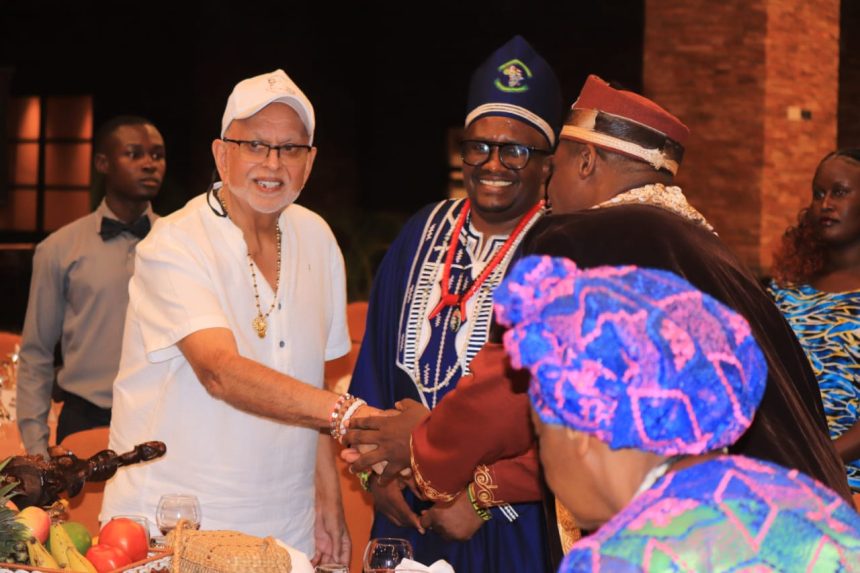
Sudhir made the commitment on Saturday, August 29, 2026, while receiving the 2026 PAP Humanitarian Award on behalf of Rajiv during the ninth edition of the prestigious awards at Speke Resort Munyonyo.
Held under the theme, “Honoring the Humanitarian Legacy of Rajiv Ruparelia,” the ceremony brought together Pan-Africanists, entrepreneurs, political leaders, humanitarians and other distinguished guests from Uganda and several other countries
Speaking briefly after accepting the award, Sudhir pledged to remain involved with the initiative and offered Speke Resort Munyonyo as the permanent venue for the annual celebration.
“I’m a man of few words. I will continue supporting and hosting these awards every year. We want to make this a home for the Pan-African Pyramids in Uganda. Thank you so much,” he said.
The pledge effectively positions Speke Resort Munyonyo, part of the Ruparelia Group, as the Ugandan home of the PAP Global Awards going forward.
Founder and organiser Andrew Irumba Katusabe said the 2026 edition received sponsorship from Sudhir, describing the businessman’s contribution as an important step towards strengthening a platform dedicated to connecting Africans and people of African descent around shared ideals of unity, humanity and continental development.
The decision to honour Rajiv came more than a year after his death, which sent shockwaves through Uganda’s business, sporting and humanitarian circles.
Rajiv, who was 35, died on May 3, 2025, following a road crash at the Busabala Flyover. He was the Managing Director of the Ruparelia Group and played an active role in the family’s business ventures, while also gaining recognition through his involvement in motorsport and charitable initiatives.
However, in paying tribute to him, Irumba said Rajiv’s significance extended beyond his accomplishments in business. He argued that the enduring value of a person’s life should be judged by the difference they make in the lives of others.
“The measure of a life is not how long one lives, but how deeply one impacts humanity,” Irumba told guests.
He drew comparisons between Rajiv and several prominent historical figures who died relatively young, including Martin Luther King Jr., Thomas Sankara, Patrice Lumumba, Steve Biko, Amilcar Cabral and Che Guevara.
Irumba said the lives of such figures demonstrate that longevity alone does not determine the significance of an individual’s contribution to society.
“This teaches us something extraordinary, that longevity is not merely a measure with the number of years we spend on Earth. It is measured by the number of lives we touch, the ideas we plant, and the humanity we leave behind,” he said.
Reflecting on his own relationship with Rajiv, Irumba recalled approaching the young businessman while developing his Pan-African initiative. He said Rajiv was among the early individuals who demonstrated practical interest in the project.
According to Irumba, Rajiv’s immediate response when presented with the initiative was to ask, “how much support was needed?”
For Irumba, the question illustrated Rajiv’s readiness to translate goodwill into tangible support rather than merely expressing interest in humanitarian and Pan-African causes.
He subsequently challenged guests to reflect on their own contribution to society by considering the positive difference their lives make in the communities around them.
“It is not simply the purity of struggle. It is the people whose lives become better because we exist,” he said.
The tribute to Rajiv was consequently presented as a celebration of his life and values rather than simply an occasion of remembrance. Irumba argued that the principles associated with Rajiv’s humanitarian work remain relevant to the wider Pan-African agenda.
He called for Pan-Africanism to move beyond speeches and symbolism and become a practical instrument for improving the lives of ordinary people across the continent.
Among the priorities he highlighted were deeper economic integration, easier movement of Africans and ideas across borders, increased intra-African trade and investment, and greater development of industries capable of processing Africa’s abundant natural resources within the continent.
“The African border should be an administrative line, not a psychological wall,” he said.
The ninth PAP Global Awards attracted participants and guests from Uganda, South Africa, Ghana, Kenya, Jamaica, Zimbabwe and the United States.
Notable attendees included former South African Member of Parliament Hon. Dr. Khanyisile Litchfield Tshabalala, Ghanaian businessman and humanitarian Clinton Arko Agyemang, United States-based Pan-Africanist Ayo Kimath and Jamaican Pan-Africanist Ms. Blossom Thomas, alongside several Ugandan dignitaries.
The event ultimately served both as a tribute to Rajiv’s humanitarian contribution and as a renewed call for Africans to embrace practical solidarity, shared prosperity and greater continental integration.